
How Risky Is Freelancing?
Plus, last chance on Club Ed Bingo!
How Risky Is Freelancing?
In the interest of full disclosure, I have to point out that I’m the kind of person who has an optimistic view of the nature of risk, which is why I’m not a financial advisor and you wouldn’t want me to be.
But I also think we are too certain that some actions are “safe” - like having a staff job. I scroll through my LinkedIn feed and all I can say is that I don’t think that’s safe at all. Not a single day passes where I don’t see a ton of people reporting massive layoffs in every industry and a ton of profiles newly sprouting the “open to work” banner.
I’ve been a freelancer for more than twenty years. And I’ve had my ups and downs, but I’ve always managed to make it work out. I’ve had to pivot from one thing to another, but that makes my work interesting and fresh.
“You will always find a way” is something my daughter tells me whenever I face a challenge, and I think if that’s the lesson she has learned from all of this, it’s a hell of a good lesson to learn.
I don’t experience freelancing as risky. I’ve always felt that freelancing has meant my future is in my own hands, not someone else’s. Being in charge of your own life is a lot less risky than being at the whim of some faceless conglomerate or toxic boss.
In fact, a staff job is the kind of thing I would experience as a terrifying risk. I would only do it if I had a side gig that I could ramp up to full time if needed.
So ... how risky is freelancing? It depends on your definition of risk.
Your Summer Fling?
New! Advanced Editing Skills: Romance
Starts June 15, 2026!
$450 (Members: $405) | How to edit romance – advanced instruction | 6 weeks | Instructor-led | Advanced
Ready to dig more deeply into editing romance? This new six-week instructor-led course is designed for editors who work with romance authors or intend to work with romance authors.
The class goes beyond the basics of genre description/definition and discussion of tropes. It delves into story problems associated with romance, including:
not establishing a conflict between the main characters
burying the story problem or introducing it too late
privileging the overt plot over the central romance
failure of the romance arc to drive character change or affect character arc
lack of distinct characterization for main characters
unclear or missing GMC for one or both of the main characters
Because romances are often part of a series, the class covers common series problems such as frontloading all the backstory, introducing all the characters in the story world all at once (even before they matter to the story), trying to force in plot events that matter to subsequent books in the series but not this one, and more.
It includes deeper dives into popular romance subgenres such as romantasy, slow-burn, vacation romance, holiday romance, and sports romance.
We’ll also touch on editing short romance fiction, such as might be included in an anthology or given away by the author to readers.
But the real standout element of this class is that it shows how to perform two rounds of development on the same manuscript, something that is helpful for any developmental editor to learn how to do. Instead of telling an author “this manuscript isn’t ready for development” you can help them make it ready.
The class shows you how to perform a manuscript evaluation (sometimes called an assessment) as the first round of development and then shows you how to perform a full developmental edit as the second round. It includes examples of how one editor has approached the edits.
A full romance manuscript is used in this class to help support a more in-depth study of the craft of editing romance. However, if time constraints make it too difficult for you to read a full manuscript, you can choose to perform your edits over a smaller chunk of the manuscript.
Each week includes a new lesson and a new assignment to be submitted for the instructor’s feedback along with online forum discussions about developmental issues.
Prerequisites: to take this class, you must have taken either the self-paced DE 1- 6 or the instructor-led Beginning and Intermediate Developmental Editing for Fiction AND Editing the Romance. The basics of editorial methodology will not be covered but students will be expected to know them.
The class is entirely online and asynchronous (you don’t have to be in any particular place at any particular time to participate) but weekly assignments are due by specific deadlines.
For more information and to register, click here.
Getting Editorial Work from Book Publishers and Packagers
Starts June 8!
$375 (Members save 10%) | How to get work from publisher clients | 4 weeks | Instructor-led | Intermediate
This is the only time this class will be offered in 2026.
This popular class is meant for editors with some experience who would like to branch out from working primarily with indie authors. The information and assignments are meant for both copy editors and developmental editors.
Face it, much as we love working with indie clients, sometimes what we’re looking for in a client is steady work, clear expectations regarding what we do, and a reliable accounts payable department.
Book publishers and packagers can make great anchor clients for freelance editors, creating a reliable base on which to rest your editing business.
But trying to get work from publishers and packagers can feel a little like searching for Yeti. Do freelancers really get work from publishers – even if they don’t know anyone at the company?
Yes! Many freelance editors of all types (developmental editors, copy editors, proofreaders) get some, most, or all of their freelance work from publishers. You could be one of them.
This class covers:
how to get the experience you need to be considered for these kinds of projects
various ways of approaching publishing companies (an irresistible letter of introduction, effective networking, and more)
the ins-and-outs of working successfully for publishing companies
Assignments include writing a letter of introduction, creating a brief marketing plan, and evaluating your skills (to make sure your edits are up to the standard publishers and packagers expect).
Each week includes a new lesson and a new assignment to be submitted for the instructor’s feedback along with online discussions about the lesson materials.
Intermediate classes are intended for those with some developmental editing experience or who have taken the Beginning + Intermediate DE for Fiction classes or the self-paced DE 1 through 6 classes.
The class is entirely online and asynchronous (you don’t have to be in any particular place at any particular time to participate) but weekly assignments are due by specific deadlines.
For more information and to register, click here.
Last Chance: Bingo for Self-Paced Classes!
Ends Sunday (May 31)!
Everyone who wins gets a $50 gift certificate from Club Ed! Sweet, right?
Here’s how it works. The bingo card below lists a number of different self-paced classes offered at Club Ed.
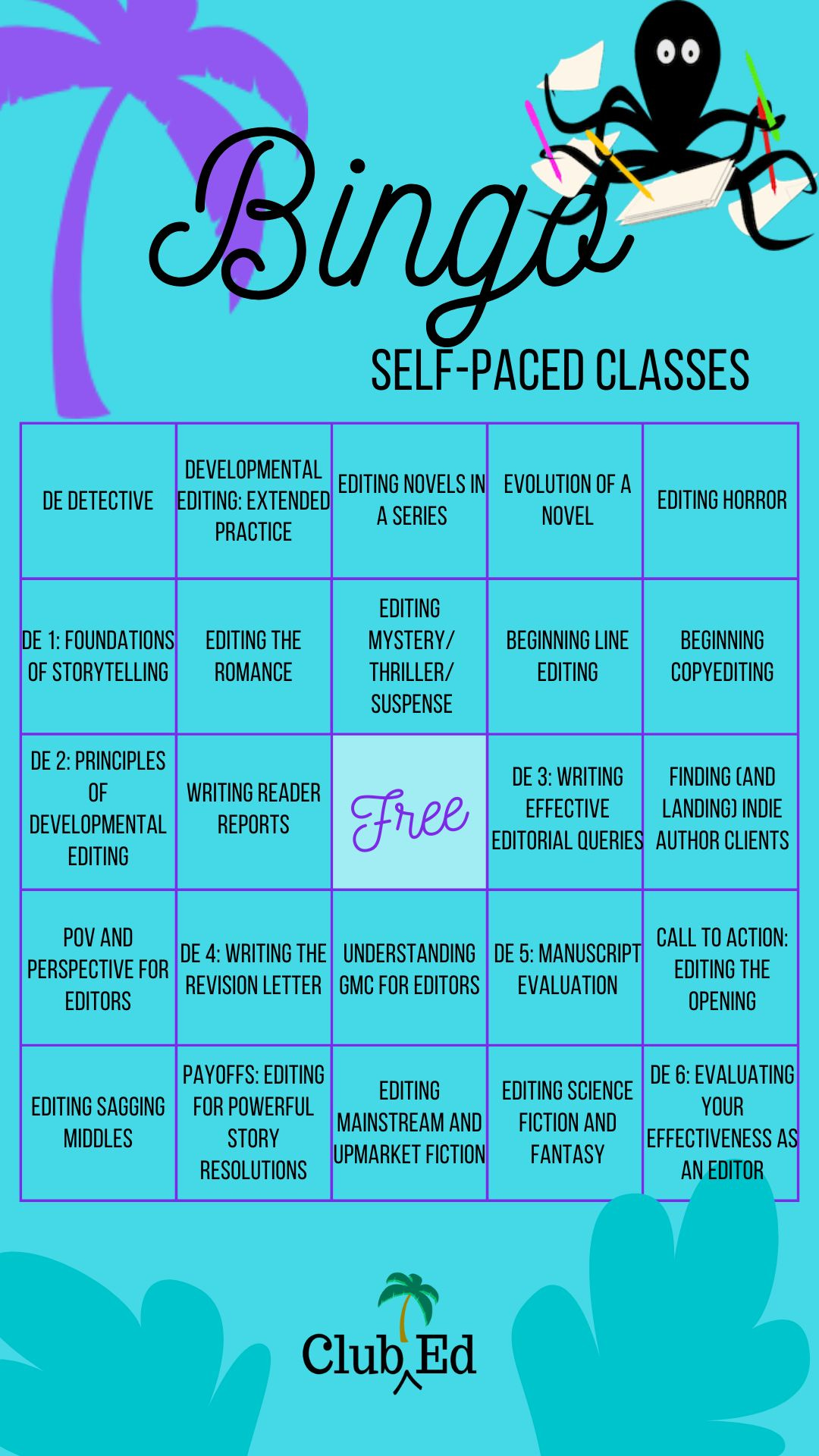
Every time you complete a class, mark it off the card. As soon as you have a bingo—that is, you have completed a full row of classes, or a full column of classes, or have completed one of the diagonals—you win!
You can play bingo with classes you’ve already taken, classes you’re working on now, and classes you buy before the game ends.
When you win (and you can see how confident I am that you will - I told you this is easy), just let me know at ClubEdResortDirector@gmail.com and I’ll send you your $50 Club Ed gift card.
We’ll be playing this game through May 31, 2026 (midnight Pacific time). You can play more than once but you can’t use the same class for more than one bingo win.
Couldn’t be easier! But if you have any questions, the above email address will find me!
For Members
The next quarterly marketing challenge starts Monday, June 22. These are held every quarter and are a fun way to meet other editors and be accountable for doing those often-dreaded marketing tasks.
Membership information (such as coupon codes for the discount on PerfectIt software and dates of the marketing challenge) can be found on the course information page in the Membership Program “class.”
Please check there first to see if the information answers your question. Thank you!
Upcoming Classes
Instructor-led classes starting soon:
Getting Editorial Work from Book Publishers and Packagers, starts Jun 8, 2026 - this is the only time this class will be offered in 2026
Advanced Editing Skills: Romance, starts Jun 15, 2026 - this is the only time this class will be offered in 2026
Editing for Plot and Story Structure, starts Sep 9, 2026
Editorial Toolkit: Coaching Writers, starts Sep 21, 2026
Editing for Character Development, starts Oct 7, 2026
About Jennifer Lawler
I help editors figure out what the hell they're doing.
If you're an aspiring, new, or established book editor or story coach, I can probably help you learn how to do the work better and more profitably.
Through Club Ed, I offer developmental editing classes, a freelance editor membership program/support group, and a slightly bony shoulder to cry on.
I've worked as an editor for more than twenty years. I learned how to edit in the trenches of traditional publishing with its insane deadlines, pitiless competition, and crushing bureaucracy. To that I added a Ph.D in English literature with a specialization in medieval literature because of a long story.
Editorial clients have included Simon & Schuster, Girl Friday Productions, Glencoe/McGraw-Hill, Barnes and Noble Custom Publishing, and others, along with many independent authors.
For fiction self-paced classes, click here.
For fiction instructor-led classes, click here
For nonfiction self-paced classes, click here
For nonfiction instructor-led classes, click here
Could not agree more about the instability of being employed by a company right now!